
You are here:HOME > PRODUCT > High speed guardrail forming machine >
High speed guardrail palletizer
13803170595

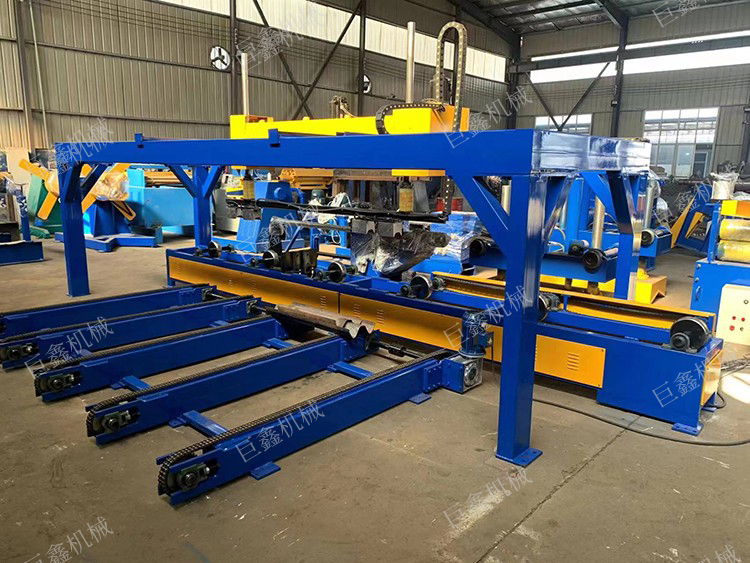
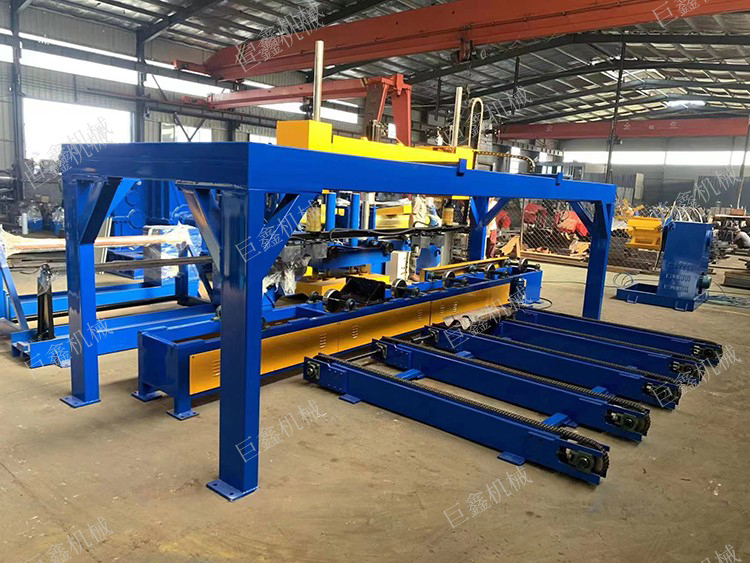
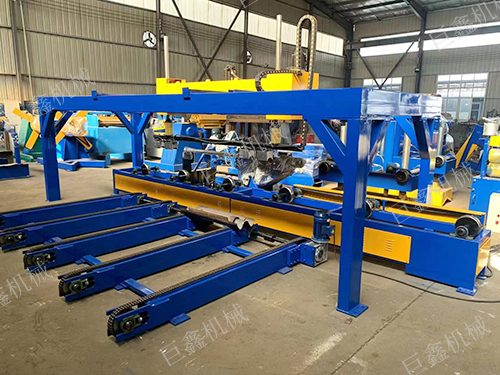
The high-speed guardrail palletizer is a specialized equipment at the end of the automated production line for waveform anti-collision guardrail panels. It mainly undertakes the cutting and unloading of finished waveform beams and panels by the guardrail forming machine, and completes the orderly stacking work through mechanized conveying, positioning correction, and layered lifting and stacking. It replaces the traditional manual lifting, sorting, and stacking heavy labor operation mode, making the stacked guardrail panel stack square and compact, easy for forklift overall transportation, storage, and loading and shipping. It is widely used in the fully automatic processing line of waveform guardrail panels on double wave and three wave highways, and plays a key role in connecting and ending the large-scale production of road traffic security components.
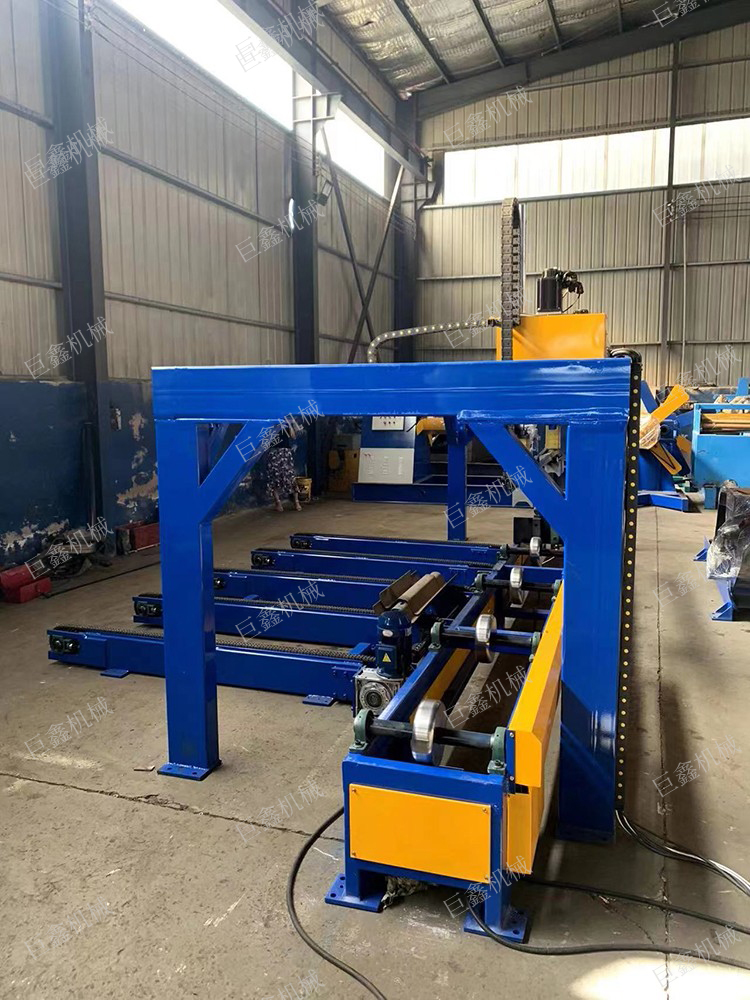
The equipment relies on mechanical transmission and hydraulic lifting to complete the entire stacking process. It can be directly connected to the discharge port of the guardrail forming machine. The formed and cut guardrail plates are smoothly fed into the feeding area of the palletizing host through the rolling conveyor bracket. The front end is equipped with a lateral limit stop frame that can be adjusted left and right. The long waveform plate is centered and corrected by the stop plate to avoid deviation and skewness during the conveying process, ensuring that the end and side of each guardrail plate remain flat when stacked. Internally equipped with a graded lifting and carrying platform, every time a board is dropped, the carrying platform will slightly lower according to the set height, reserving space for board placement layer by layer. During the stacking process of multiple layers, the boards will adhere to each other without any curling, misalignment, corner collision, or scratching of the galvanized anti-corrosion coating, fully preserving the appearance and anti-corrosion performance of the finished guardrail board. The entire set of homework is purely mechanical and physical actions, which will not cause compression deformation to the corrugated structure and punching installation holes of the guardrail board, ensuring the integrity of the finished components throughout the process.
The main frame of the whole machine is formed by welding thickened square tubes and steel plates together. After welding, it undergoes aging stress relief treatment to eliminate the internal stress caused by welding stress in the frame. Under long-term heavy load conditions of carrying heavy steel plate stacks, the frame is not prone to problems such as column tilting, beam twisting, and lifting track deformation. The stability of equipment operation can be maintained for a long time. The conveyor roller adopts wear-resistant solid shafts combined with nylon sheathed rollers, which rotate smoothly and have moderate friction. The corrugated board slides on the roller without being easily stuck, while reducing friction scratches on the board surface. The lifting system adopts a hydraulic cylinder driven chain synchronous lifting structure, and the double-sided chains synchronously drive the up and down displacement of the load-bearing platform. The balance of the lifting process is good, and the table will not tilt unilaterally. When multiple layers are fully loaded and stacked, the force is uniform, avoiding the risk of stack overturning. The transmission sliding components such as chains and guide rails have undergone wear-resistant hardening treatment, which can adapt to the production environment of multi metal debris and dust in the workshop.
The positioning and limit mechanism has been optimized for targeted adaptation, and the lateral baffle can be adjusted for width through hand cranked screws. The limit spacing can be adjusted according to different width specifications of double wave and triple wave guardrail panels, and is compatible with the stacking requirements of multiple types of guardrail panels. Set up material blocking limit plates at the ends to uniformly constrain the extension length of the boards, ensuring that the ends of the entire stack of guardrail boards are neat, and the subsequent bundling, packaging, lifting, and transportation are balanced in stress. The lifting stroke and single descent height can be freely set in the control system according to the thickness of a single board. The number of stacking layers and the placement quantity of each layer can also be modified as needed, flexibly matching different storage and loading requirements. The hydraulic power unit is equipped with an oil circuit filtering device and an overload relief protection structure. When the table load exceeds the rated range or foreign objects block the lifting mechanism, the oil pressure is automatically released to protect core load-bearing components such as oil cylinders, chains, and frames, and improve the safety factor of equipment operation.
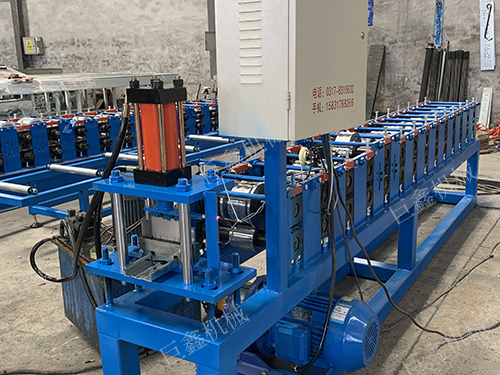
The equipment is equipped with an integrated electrical control system, which uses a programmable controller combined with a touch control panel. The interface functions are clearly divided, and operators can directly set parameters such as stacking layers, lifting speed, single stop delay, and conveyor start stop rhythm on the screen. The system automatically performs cyclic actions such as board feeding, alignment, board dropping, and table lowering, without the need for manual real-time monitoring. The control system reserves a signal docking port, which can achieve signal linkage with the front-end guardrail forming machine. The discharge signal of the forming machine synchronously triggers the conveying action of the palletizer, and the entire production line forms a closed-loop fully automatic operation. The equipment is set up in two modes: manual jog debugging and automatic continuous operation. During the debugging phase, the lifting, conveying, and limit actions can be tested in single steps. During batch production, the automatic mode is turned on for uninterrupted operation. The operation logic is simple and intuitive, and the staff can independently complete parameter setting and daily start stop management after a brief familiarization. The electrical control cabinet is designed with dust-proof, shockproof, and moisture-proof protection, suitable for use in heavy-duty steel structure processing workshops with high vibration and dust levels, reducing the probability of line short circuits and component aging failures.
In terms of the overall supporting logic of the production line, this equipment completes the last stage of guardrail plate processing from coil unwinding, roll forming, fixed length cutting to finished product collection. After forming, the guardrail plate does not require multiple workers to handle and organize it on site. After automatic stacking is completed, forklifts can directly pick up the entire stack of materials, greatly reducing manual input at the back end. At the same time, the neat stack can improve warehouse space utilization, and the stacking is more stable when vehicles are loaded, reducing the probability of plate collision and damage during transportation. In addition to conventional high-speed waveform guardrail panels, it can also be adapted to the receiving and stacking of regular long metal sheets such as small anti-collision columns and reinforced pads, with certain production line expansion and adaptation capabilities.
The daily operation and maintenance process of the equipment is simple and convenient. A semi enclosed protective fence is installed outside the whole machine to prevent metal debris and workshop dust generated by cutting from falling into the lifting chain, hydraulic valve group, and electrical junction box, slowing down the wear and aging speed of components. All moving points such as chains, guide rails, and bearing seats are equipped with standardized lubrication nozzles, and lubricating grease is added according to a fixed cycle to ensure smooth operation of the lifting mechanism and conveyor roller, reducing mechanical friction losses. The hydraulic system only needs to regularly check the cleanliness of the oil, replace the hydraulic oil and filter element on time to maintain stable lifting power. The electrical part only needs to regularly clean the dust inside the control cabinet and tighten the wiring terminals, without the need for complex professional maintenance operations, which is in line with the normalized equipment maintenance management mode of the guardrail plate processing plant.
The regularity of finished fence board stacking directly affects the efficiency of warehouse management, the safety of lifting and transportation, and the appearance of finished products at the factory. Automated palletizing equipment, with its continuous and stable operation ability and precise positioning and lifting structure, effectively compensates for the shortcomings of uneven manual stacking, high labor intensity, and many safety hazards. This high-speed guardrail specific palletizer relies on a rigid and sufficient machine frame, a synchronized and stable hydraulic lifting system, adjustable limit positioning components with multiple specifications, and an intelligent electronic control system that can be linked to the production line. It perfectly matches the back-end collection requirements of large-scale continuous production of waveform guardrail panels. With its broad pattern adaptation ability, simple operation logic, and low-cost long-term operation and maintenance characteristics, it improves the overall automation level of the fully automatic production line for highway security guardrail panels, and provides complete automation equipment support for the industrial processing of transportation infrastructure components.
High speed guardrail panels are suitable for long-distance protection scenarios, with the advantages of strong anti climbing performance and durable structure, especially suitable for outdoor long-term exposure environments.
High speed guardrail, also known as waveform anti-collision guardrail: The main body is made of national standard Q235 low-carbon steel plate, which is cold-formed into a corrugated shape. The columns are mostly made of steel pipes, and the surface is hot-dip galvanized or sprayed with anti-corrosion treatment.
New materials: Some road sections have started to test high-strength weather resistant steel to reduce steel consumption and improve corrosion resistance, but Q235 is still the mainstream material at present.
Steel has high strength, good toughness, and plasticity, and can withstand large impact forces without easily deforming or breaking. In high-speed guardrails, steel usually appears in the form of hot-dip galvanized steel pipes or cold-rolled steel plates. After hot-dip galvanizing treatment, a dense zinc layer is formed on the surface of the steel, effectively preventing corrosion of the steel and extending the service life of the guardrail. In addition, steel guardrails can also be sprayed with plastic as needed to increase their aesthetics and weather resistance.