
You are here:HOME > PRODUCT > Single layer tile press machine >
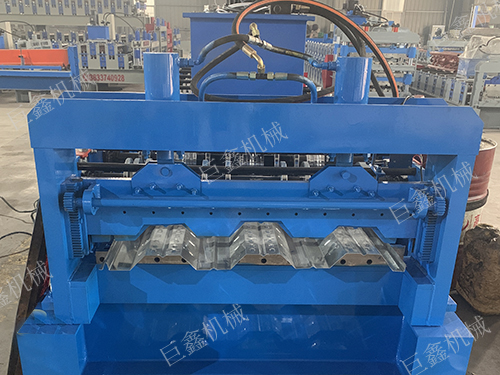
750 floor loading machine
13803170595

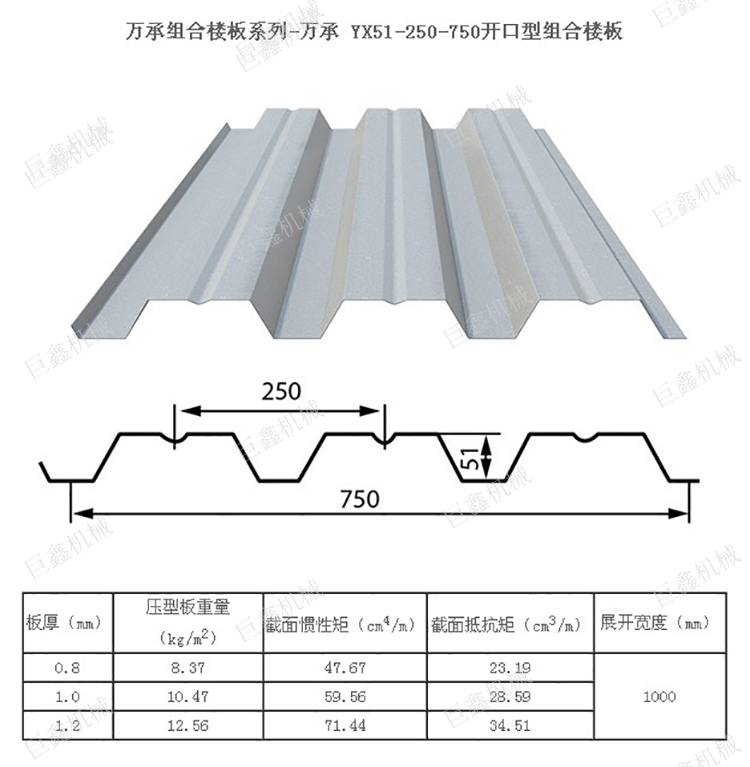
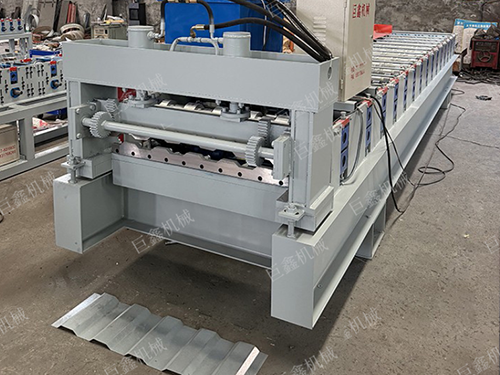
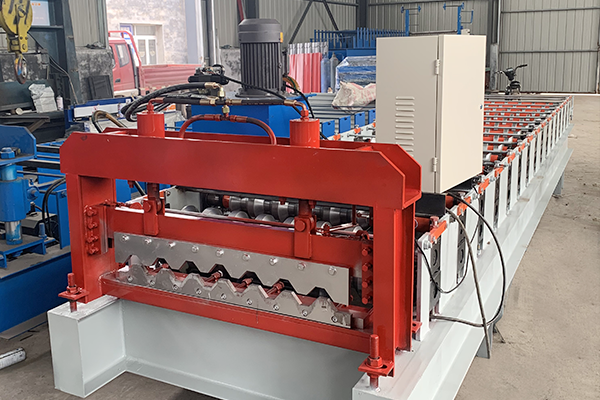
The 750 type floor support plate machine is a specialized equipment for cold bending roll forming used in steel structure construction projects. It mainly uses metal coils such as galvanized steel strips and aluminum zinc alloy steel plates as processing materials, and continuously and gradually bends them through multiple sets of rollers to form 750 specification building load-bearing floor support plates. The formed sheet is laid on top of the steel structure main beam and can be combined with concrete pouring to form a composite floor system. It is widely used in the load-bearing structure of high-rise office buildings, large commercial complexes, multi story industrial plants, underground garages, warehousing and logistics centers and other large and medium-sized buildings. It can share the concrete load and shorten the on-site construction period. It is an indispensable supporting building material processing equipment for modern prefabricated steel structure buildings. The equipment has been fully optimized according to the overall export standards, taking into account long-distance transportation of ocean containers, differences in industrial power supply parameters in different countries, high dust and large temperature fluctuations in the production environment of the factory area. It has been adapted and upgraded in multiple dimensions such as modular disassembly and assembly design, electrical system universality, overall structural bearing capacity, and geometric accuracy of sheet metal forming, which can meet the installation conditions of various overseas construction sites and the operational needs of long-term continuous large-scale production.
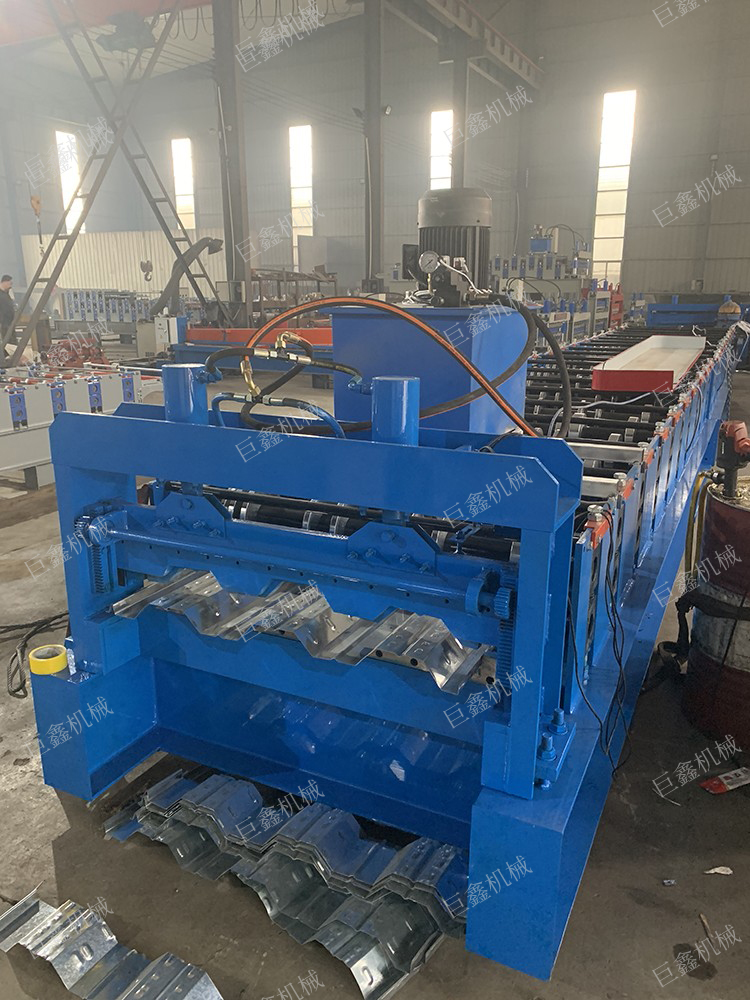
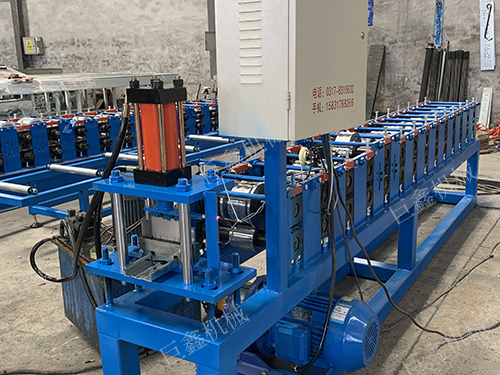
The whole machine adopts a modular modular combination structure, which is disassembled into five independent functional modules: the coil feeding support frame, the plate leveling and guiding correction mechanism, the main building bearing plate roll forming assembly, the hydraulic fixed length cutting unit, and the independent sealed electrical control box. The core advantage of modular split design is the effective compression of the loading space inside the container. Each functional unit can be individually packaged, reinforced, and fixed, greatly reducing transportation losses such as external compression deformation of heavy-duty frames, precision rolling mill scratches, hydraulic pipeline bending and leakage during ocean lifting and long-distance transportation across regions. After the equipment arrives at the target site, the operators follow the matching assembly instructions to complete the alignment and splicing of each module, tighten all connecting bolts, and connect the hydraulic oil pipeline and electrical control circuit to complete the whole machine assembly. The professional technical requirements for on-site assembly personnel are relatively moderate, and they can adapt to limited installation conditions such as overseas simple processing workshops and temporary outdoor processing sites. The main frame of the equipment is made of thickened steel and welded together. All welding seams are finely polished, deburred, and stress relieved. The exterior is coated with multiple layers of anti rust and anti-corrosion protective coatings. Faced with the working environment of workshop dust accumulation, high air humidity, and obvious temperature difference between day and night in all seasons, long-term continuous operation is not prone to structural hazards such as frame shaking, paint peeling, and welding point rusting and loosening, ensuring the rigidity and stability of the whole machine operation.
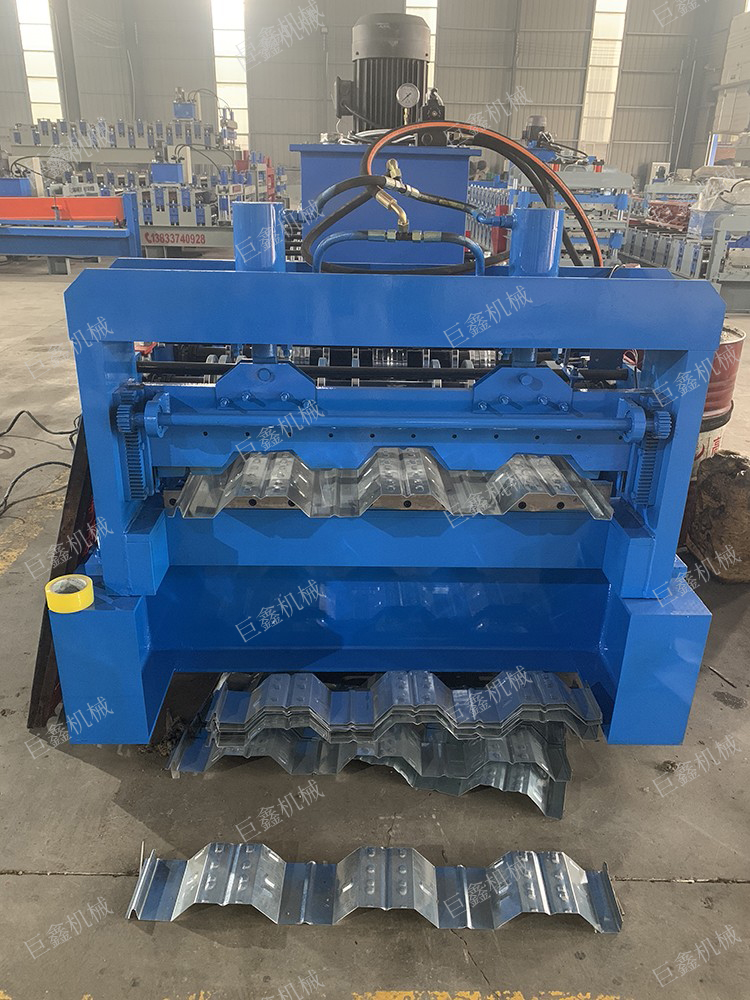
The core building support plate forming roller assembly is a key component that determines the mechanical structure dimensions and appearance flatness of the 750 plate. The roller wheel is processed by precision CNC lathe and surface hardening strengthening treatment, and the surface of the roller body is smooth and wear-resistant. During repeated rolling and conveying of galvanized coil, the protective coating on the surface of the plate will not be damaged. Multiple sets of forming rollers are arranged in an orderly manner according to a step-by-step bending logic. Through multiple rolling processes, the web height, rib pattern, and double-sided overlap structure of the floor support plate are gradually shaped to avoid stress concentration inside the metal sheet caused by a single large angle bending, resulting in adverse conditions such as plate cracking, coating detachment, and plate shape rebound deformation. After continuous and uniform shaping of the entire set of roller tracks, the rib height, bite width, and flatness of the finished floor slab can be maintained at a uniform height. The splicing and fitting between the slabs are smooth, and the overall stress is uniform after laying. When combined with concrete, the grip force is sufficient, which can fully exert the load-bearing performance of the composite floor slab. The entire set of rolling mills is synchronously driven by a reducer combined with a high-strength synchronous transmission chain, with transmission clearance controlled within a small range. The vibration amplitude of the equipment during operation is gentle, and the operating noise is maintained within a reasonable range. Long term uninterrupted batch processing can still maintain uniform feeding, and the size error of a single batch of finished boards can be stably controlled.
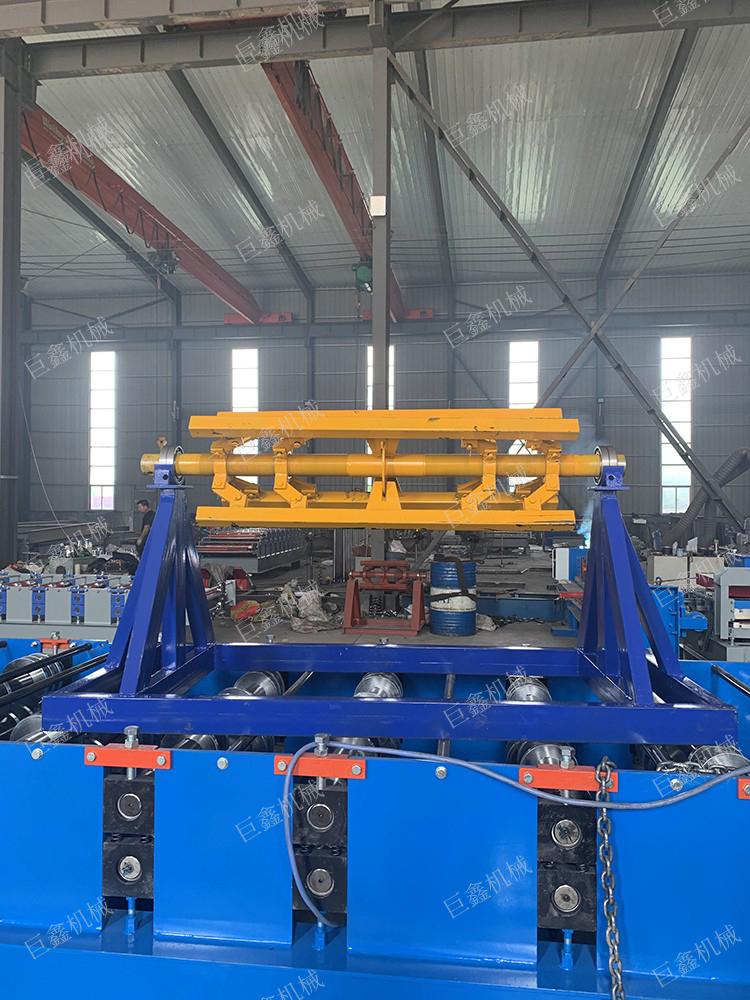
The front end of the equipment feeding is equipped with heavy-duty coil placement brackets and plate leveling and correction components. After the thick galvanized coil is placed in place, it is stretched by multiple sets of parallel flattening rollers to fully release the residual stress inside the plate, allowing the plate to be smoothly fed into the forming track in a completely horizontal and straight state, reducing common operating failures such as material deviation, one-sided jamming, and misaligned rib pattern formation from the source. The speed of equipment feeding can be flexibly adjusted according to the thickness of raw materials and on-site production plans. It has good material adaptability for various types of galvanized metal coils in the commonly used thickness range of construction projects. The feeding process is smooth and continuous, and it is not easy to cause production interruption problems such as material blockage, jamming, and shutdown.
The cutting execution unit adopts a stable guided hydraulic cutting structure, combined with a high-precision pulse length counting device to achieve fully automatic fixed length cutting operation. The operator inputs the target length parameters required for a single floor support plate on the control panel interface, and the equipment automatically completes the feeding and conveying, multi-stage continuous roll forming. When the plate reaches the preset length value, the hydraulic knife holder smoothly descends to complete the horizontal cutting, and the cutting section is smooth and polished, without any appearance defects such as curled edges, burrs, plate compression depressions, corner warping, etc. The length error of the single finished product is controlled within a reasonable range, and the specifications of the floor support plate produced in batches are highly uniform. The finished sheet material that has been cut automatically slides down to the rear discharge rack, forming a complete automated closed-loop production line from the loading of the coil material to the unloading of the finished product. Only one staff member is responsible for the supply of the coil material and the inspection of the overall operation status, minimizing the size deviation caused by manual intervention.
The electrical control system has been specially adapted and upgraded for export scenarios. The internal core electrical components are selected from internationally recognized industrial accessories, supporting free switching of multiple voltage levels. It can accurately match the industrial power supply parameters of different countries and regions, avoiding hidden dangers such as equipment failure to start due to voltage standards and overheating and burning of electrical components. The operation control panel interface is simple and intuitive, the parameter setting logic is easy to understand, and it integrates multiple safety protection mechanisms such as motor overload protection, emergency stop braking, and automatic operation fault prompt. Once the system detects abnormal working conditions such as plate jamming, motor load exceeding the standard, and hydraulic system pressure abnormality, the equipment will immediately stop and lock, effectively protecting the core transmission components and hydraulic system from overload losses, and comprehensively improving the safety factor of the entire operation. All internal circuits of the equipment are neatly bundled and stored, and the control box is equipped with a thick sealed protective shell, which has basic waterproof, dustproof, and moisture-proof performance. It can be stably and continuously operated in open simple factories and outdoor processing areas for a long time.
This device has low constraints on the site conditions for ground use, only requiring a flat and hardened concrete floor to place the entire machine and tighten the anchor bolts. There is no need to dig and pour specialized equipment foundations, and after simple debugging, it can be officially put into mass production. The daily maintenance process in the later stage is simple and easy to operate. It only requires regularly adding lubricating grease to the rotating points such as the transmission chain and bearings, cleaning the metal debris and floating dust impurities accumulated on the surface of the rolling mill, and checking for oil leakage in the hydraulic pipeline joints. The disassembly and replacement steps of vulnerable parts are simple and intuitive, making it easy for overseas users to independently complete routine maintenance and parts replacement work.
The 750 type floor slab is widely used in multi story and high-rise steel building floor systems worldwide due to its scientific cross-sectional structure, excellent load bearing capacity, and convenient on-site pouring construction advantages. This export version of the 750 type building support plate machine has completed comprehensive optimization and upgrading around four core directions: ocean logistics disassembly and packing, multi country voltage compatibility and adaptation, tolerance to complex factory environments, and high-precision and stable forming of load-bearing plates. It relies on mature and reliable multi-stage cold bending forming technology to continuously produce standardized steel structure load-bearing floor slabs, providing solid and reliable industrial equipment support for the automation processing of building materials for overseas prefabricated high-rise buildings, and meeting the actual needs of large-scale and standardized production of steel structure construction industries in various regions.
Process: feeding → leveling → guiding → continuous cold bending forming → fixed length cutting
Unloading and unwinding: The hydraulic unwinding machine carries the steel coil and smoothly discharges the material.
Plate leveling: By using a leveling machine to eliminate the curling stress of the steel coil, it is confirmed that the plate entering the forming machine is properly leveled.
Guided feeding: The guiding device confirms that the sheet is aligned and smoothly enters the forming host.
Fine forming: The flat steel plate is gradually cold-formed into the designed closed or open plate shape through more than ten (or more) finely arranged rollers.
Fixed length cutting: After forming, the continuous strip is measured in detail by an encoder or PLC, and when it reaches the set length, it is cut by hydraulic pressure.